Russell Barkley: AD/HD is No Gift

Russell Barkley, PhD  is professor at the Medical University of South Carolina, and author of more than 200 scientific articles and book chapters on Attention-Deficit/Hyperactivity Disorder. Here, he has a few words for the overzealous:

… Many people may be gifted and talented in various aspects of these other human abilities, but never attribute that giftedness or that success to the AD/HD itself … I want people to understand that while people might be gifted and talented and successful in spite of their AD/HD, it is not because of their AD/HD. The AD/HD itself may, in fact, make you less effective than other people who have equally talented areas in those human abilities.

He’s addressing the Center for AD/HD Awareness, Canada, but he aims fire at all who suggest the disorder brings talents and blessings.

Some writers propose innate distractibility is just the thing for a multi-tasking world.  Sadly, it’s not enough to shift attention rapidly among tasks. You also have to return to those tasks to finish them; difficulty doing so is criterion 1D for the disorder. Lara Honos-Webb, PhD has written several books suggesting AD/HD may bring such vague, unverified capacities as, “attunement to nature,”  and “emotional sensitivity.”  In The Gift of Adult AD/HD, she asks, “Are mistakes and sloppiness anything less than perceiving the world in a way that opens up possibilities?” The answer is yes – much less.  Creativity can involve serendipity. Mistakes and sloppiness are failures to perceive you’ve forgotten to unplug the iron or to add the most important ingredient to a dish. Her books provide helpful coping techniques, but they fall flat when they claim AD/HD is a boon. Consider its’ co-morbidity with  depressive and anxiety disorders and it  appears much more of a curse.

Funny t-shirt. See if you can find the gift in this flow of thought.

Funny t-shirt. See if you can find the gift in this flow of thought.

Barkley’s criticism isn’t aimed at optimists, but those who leave the facts behind. This blogger writes of how he loves (!) his AD/HD. Not because there is anything to love about it, but because nothing is worse than negative thinking.  Barbara Ehrenreich would disagree. In her 2009 book Bright-Sided, she uses America’s vulnerability to the Sept. 11th attacks to show how positive thinking can have drastically negative consequences:

There had already been a terrorist attack on the World Trade Center in 1993; there were ample warnings, in the summer of 2001, about a possible attack by airplane, and flight schools reported suspicious students like the one who wanted to learn how to “fly a plane but didn’t care about landing and takeoff.” The fact that no one — the FBI, the INS, (President George W.) Bush, or (national security advisor Condoleeza) Rice — heeded these disturbing cues was later attributed to a “failure of imagination.” But actually there was plenty of imagination at work — imagining an invulnerable nation and an ever-booming economy — there was simply no ability or inclination to imagine the worst.

Positive thinking encourages people to feel good about themselves, but as Ehrenreich points out, it inevitably carries  harsh, invalidating personal judgments. Are you feeling depressed, angry or uncertain because neurology makes you look like a screw-up? Drop the ‘victim mentality’, ya whiner!

‘Positive’ is nice. ‘Realistic’ is far more important. As Dr. Barkley said to patient advocates at the conference:

It’s going to be very hard for society to take you all seriously if you continue to trumpet this disorder as a gift. There is no way that we can go to Ottawa and walk the halls of Parliament arguing for accommodations, entitlements, funding of AD/HD medications on the one hand, while rah-rah cheering AD/HD as this wonderful giftedness that we have and you don’t.

What’s worse than negative thinking? Falsely boosting people’s self-esteem with unsubstantiated claims that skew public understanding of the disorder. There’s a real danger that attitudes on AD/HD could go from, “There’s no such thing,” directly to, “Why should we make accommodations for your son? Doesn’t he has the gift of AD/HD?”

@ 2013 Jonathan Miller All Rights Reserved

8 Comments

Filed under AD/HD

One More Reason to Quit Smoking

Chill out, pal. Relax. Just don’t smoke a cigarette. Tobacco may make your anxiety worse instead of better.

1933 Lucky Strikes ad. "To anxiety ... I bring relief."

Tobacco ads once implied smoking improved your health by reducing anxiety. Ha-ha! Good one, guys.

Máirtín S. McDermott, Theresa M. Marteau, et al, tracked 491 smokers as they tried to quit.  After six months, 76% of the participants had relapsed, and only ten of those with a psychiatric diagnosis (mostly anxiety and depression) were still tobacco-free. Those who quit reported their anxiety score went down by an average of seven points, while those who relapsed scored three points higher than before.  Which group saw their anxiety drop the most after they quit, or soar the highest when they relapsed? Those who said they smoked, “to cope,” as well as for pleasure.

All the usual caveats apply. 491 smokers is not the world’s largest sample. Pharmaceutical companies didn’t pay for the study, but they’ve paid McDermott to work on smoking-cessation before.  A different  study recently found exactly the opposite effect; these researchers believe low doses  of nicotine (not standard doses or high doses) may clog  a subclass of the brain’s nicotine receptors so they can’t relay anxiety signals. On the other hand, those researchers studied mice rather than people, and most first-time smokers report nausea rather than serenity.

Too many people smoke, and too many rationalize tobacco use by saying, “I need it for my nerves.” We can boost our client’s motivation to quit by explaining tobacco  actually seems to increase anxiety – through our fears for our health, if no other way.

“Sure, cigarettes help you relax,” I’ve said. “They take away the anxiety you get from craving a cigarette.”

Citations:

Change in anxiety following successful and unsuccessful attempts at smoking cessation: cohort study
McDermott MS, Marteau TM, Hollands GJ, Hankins M, Aveyard P British Journal of Psychiatry, 2013; 202: 62-67

Anderson SM, Brunzell DH (2012) Low Dose Nicotine and Antagonism of β2 Subunit Containing Nicotinic Acetylcholine Receptors Have Similar Effects on Affective Behavior in Mice. PLoS ONE 7(11): e48665. doi:10.1371/journal.pone.0048665

@ 2013 Jonathan Miller All Rights Reserved

Leave a comment

Filed under anxiety

“Six Harsh Truths” and depression

David Wong‘s Six Harsh Truths That Will Make You a Better Person is a New Year’s essay for those who lack resolution – one that applies directly to treating depression.

If you want to know why society seems to shun you, or why you seem to get no respect, it’s because society is full of people who need things … the moment you came into the world, you became part of a system designed purely to see to people’s needs.

 Either you will go about the task of seeing to those needs by learning a unique set of skills, or the world will reject you, no matter how kind, giving and polite you are. You will be poor, you will be alone, you will be left out in the cold.

 Does that seem mean, or crass, or materialistic? What about love and kindness — don’t those things matter? Of course. As long as they result in you doing things for people that they can’t get elsewhere.

He’s talking to those paralyzed by the dissatisfaction they feel with their lives, and that includes those with Major Depressive Disorder. As  Marsha Linehan pointed out, the best medicine for unpleasant emotions is often the opposite of what the emotion makes us want to do.  “Opposite action” is Wong’s prescription for those who are disgruntled but inert: do something. Anything. Anything  more than what you do now, that would also be useful to others. He stands with  Roy F. Baumeister, whose research shows we don’t achieve because we have good self-esteem. Per the Florida State University researcher, if there’s a relationship between the two variables,  it’s much more likely we have good self-esteem because we achieve.

It’s a shame Wong builds his argument on Alec Baldwin’s role in Glengarry Glen Ross as a manager who shames and threatens his sales force.  Who gets motivated from abuse? Those galvanized by anxiety – the sort of highly-motivated go-getters who rarely need our help. Wong doesn’t scorn his readers for freezing in fear of rejection and failure. His point is simpler: the world values you for what you do. You can be valued more highly by doing more.

In cognitive-behavioral therapy, the most effective reframes for thoughts of, “I’m worthless,” are usually about accomplishments – grades the client earned, projects they completed, people they have helped. Once I’ve helped a client identify all of the reasons they aren’t garbage, I’m going to ask, “Now that we’ve settled that, what do you want to do that would make you even more worthwhile?”

@ 2013 Jonathan Miller All Rights Reserved

2 Comments

Filed under depression, Uncategorized

Ritalin Reduces the Crime Rate

Somebody said she said something about don't let them give your kids Ritalin. (photo copyright 2012 by Alan Light)

Somebody said she said something about don’t let them give your kids Ritalin.
(photo copyright 2012 by Alan Light)

When I worked with disruptive children in North Philadelphia, many mothers were adamant about medication for AD/HD. “I want him to get over this on his own,” they’d say. “I need him to grow up right.”   I’d explain AD/HD is a neurological disorder. They’d cite the most influential woman in the world:  “Oprah said that’s a bad idea.” At least, they thought their neighbor said they remembered the talk-show host said something about it. They were determined their children would not grow up to be one of the local thugs or addicts. They were sure it would happen if they relied on pills.

A new study in the New England Journal of Medicine suggests they may have had it backwards. Paul Lichtenstein, Ph.D., Linda Halldner, M.D., Ph.D., et al at the Karolinska Institutet in Stockholm, Sweden, studied 25,000 people diagnosed with AD/HD from 2005 to 2009. They found the group that took meds committed fewer crimes than the group that didn’t. They found that individuals broke the law less when they took medication than when they didn’t.  Medication alone reduced criminal acts by 32%.

AD/HD is estimated to be two to sixteen times more common in prisoners than the general population. The famed Milwaukee Study (ongoing since 1977!) at The Medical College of Wisconsin has shown those with AD/HD are three times as likely to get into fights, destroy property or break into other’s homes as those without. Lichtenstein, Halldner, et al’s finding fit well with earlier studies which found those who are properly medicated for AD/HD are three to four times less likely to become addicted than those without.

In North Philadelphia, we suspected as much.  If we’d had the numbers to substantiate our hunches, it wouldn’t have meant much to our clients’ mothers. They cared about character;  they didn’t see that AD/HD meds help children persevere long enough to develop it. Over three years of struggling to get parents and teachers to implement behavior-mod plans, I became twitchily resentful towards Oprah.  If the topic was the most effective tool for treating AD/HD, her name always seemed to come up.

My souvenir of my first counseling job: an irrational annoyance towards a woman I’ve never met, over something she almost certainly never said.

Citation:

Medication for Attention Deficit–Hyperactivity Disorder and Criminality
Paul Lichtenstein, Ph.D., Linda Halldner, M.D., Ph.D., Johan Zetterqvist, M.Ed., Arvid Sjölander, Ph.D., Eva Serlachius, M.D., Ph.D., Seena Fazel, M.B., Ch.B., M.D., Niklas Långström, M.D., Ph.D., and Henrik Larsson, M.D., Ph.D. N Engl J Med 2012; 367:2006-2014 November 22, 2012 DOI: 10.1056/NEJMoa1203241

@ 2013 Jonathan Miller All Rights Reserved

1 Comment

Filed under AD/HD

Stress Management Blogging #4

1 Comment

Filed under Stress Management Blogging

Successful Branding: Don’t Be a Therapist

Interesting New York Times article here about a rookie therapist who sought branding experts’ help in building her private practice. It seems the key to success is to choose a hyper-specific niche, tweet banalities, study pop culture, make borderline-inappropriate self-disclosures,  be available 24/7, treat clients via text message, reassure them they don’t need to make changes and downplay the fact you’re a therapist.

On that note, I’m going back to bed.

@ 2012 Jonathan Miller All Rights Reserved

3 Comments

Filed under Uncategorized

On Resentment

Photo copyright 2012 by Jenny Rollo“Resentment is the most precious flower of poverty” – Carson McCullers

On the third Thursday of each November, we Americans bow our heads and meditate on all we are thankful for. For those of us who like our turkey tartened with cranberry sauce, here are a few thoughts on gratitude’s opposite.

What is Resentment?

The word begins with the prefix re (as in repeat) and adds from the Latin sentire – to feel. Ordinary anger flares up and is quenched. Resentment is felt over and over. Vengefulness takes action. Hostility and rage lash out.  Resentment is passive and slow-fermenting. One can be bitter at life in general, but we are resentful towards people. We feel prejudice because of who others are, but we are resentful over what others have done.  Or not done. No one begrudges basement inventors their new-found wealth, but blue-collar teens are often resentful towards rich kids who did nothing to deserve designer clothes or private-school education.

Philosopher Robert C. Solomon pointed out resentment involves inferiority; we resent our siblings for taking up more of our parents’ time and attention. Like all anger, resentment involves the perception of victimization. If our younger brother gets more maternal love, we get less. Resentment is often misplaced; Li’l Brother didn’t ask to be Mom’s favorite, after all.

Photo copyright 2012 by Kavitha ShivanThere’s even a special type of resentment when it affects our perceptions of the world: ressentiment. Per thinkers such as Kierkegaard and Nietzsche, ressentiment means you’ve invented a morality-based explanation of your inferior position. Your children won’t talk to you? Those selfish ingrates should thank you for raising them with discipline. When you believe you have lost because you are the better person, ressentiment protects your self-esteem but blinds you to your role in the problem.

Why feel resentful?

Resentment is painful and corrosive. Most resentment advice minimizes to two words: “Stop it.” What use could such a toxic feeling serve? It could enforce social norms by punishing those who act haughty and superior. It also could be protective. In the 1980s, political scientist Robert Axelrod wrote computer programs to test strategies for “Prisoner’s Dilemma” games, where success depends on smart choices on whether to cooperate with another. The most successful strategy was to cooperate with those who cooperated in earlier rounds and to thwart those who didn’t. Resentment reminds us who didn’t cooperate. When you pick at a scab, the wound will never heal, but you’ll never lose your reminder of how you were hurt.

Photo copyright 2012 by Emiliano SpadaHow can we work through it?

The Big Book Bunch  encourages those in recovery to write out a four-column summary of their resentments, and to examine the role they may have played in the problem. Taking responsibility can ease resentment, as long as that responsibility is present. A middle child who resents the youngest for taking up her parents’ attention can’t take responsibility for being born between siblings, for the younger child’s greater needs for parental attention, or for the parents’ limited supply of time and energy. Rational-Emotive Behavioral Therapy provides a less-invalidating approach: examine our beliefs about the situation, so we can shift our feelings from paralyzing resentment to healthier negative emotions, such as sorrow, disappointment or grief.

Discussion of healthier emotions (that is, those that lead us to more constructive, motivated thinking) raises the Thanksgiving Day question: If we’re trying to move back to healthier emotions, shouldn’t we try to shift to gratitude? Possibly not. As Ronnie de Sousa points out in a review of one of Solomon’s books, to be grateful to someone is to be in their debt. And to be in their debt is to place yourself in a position of subservience to them. And positions of subservience can lead straight back to … resentment.


@ 2012 Jonathan Miller All Rights Reserved

Leave a comment

Filed under Uncategorized

What I learned from the Ethics refresher

Continuing education in counseling ethics is … Hey! Don’t nod off yet. Continuing ed in ethics is like tap water; flavorless and uninspiring, yet essential to our functioning. Caught short on ethics credits with license renewal slouching my way, I chose to go back to the basics.

An example of how exciting continuing education in counseling ethics is not.

I knew I would know most of the material. It meant passing up  advanced seminars with alluring promises of bullet-proof protection against lawsuits. But it’s too easy to get complacent about fundamentals. At risk of looking moronic to the more-recently educated, these seven points from Bruce J. Spencer’s “Applied Ethics” course caught my eye:

1. Bartering can be okay. 

Trading therapy sessions for goods or services has long been a no-no. There’s a high risk someone will wind up dissatisfied, and that will affect therapy. Spencer suggests it can be okay – in specific circumstances. If your client lacks health insurance or better options to pay, and the client likes the proposed deal, and a peer reviews it and agrees it seems fair,  and it’s written up in a formal contract,  then bartering might be appropriate. As unlikely as it seems, Spencer suggests that in impoverished areas with limited mental health services, bartering may be the most ethical choice.

2. How long to keep records? Maybe forever. 

State laws tell us to keep records between five to seven years. That may not be long enough. Per Spencer, there have been many cases where clients filed suit over years-old psychotherapy sessions.  With the documentation destroyed, the therapists had nothing in their defense except their word. Spencer suggests we save records of those dyspeptic clients who may grow disgruntled in future. Considering a career’s worth of electronic files can fit on a flashdrive the size of one’s thumb, one wonders if there’s a reason to dispose of any client’s records, ever.

3. Burn-out is a loss of faith.

If you can’t believe you can help others anymore, you’re probably right.

Most people view ideals and altruism as pleasant abstractions. Spencer sees them as essential to ethical practice.  To counsel clients, you have to believe (a) they can get better and that (b) you can help them do it,  (c) through therapy. When you’ve lost that confidence, you may play the role of a therapist, but you won’t perform effectively.

4.  Don’t put anyone else’s name in a chart.

You want to refer to people in your client’s life as, “The client’s second husband,” or “The client’s oldest daughter.” If the records ever get called into court and others are identified by name, those names will have to be redacted.

5. Not following up on homework could get you in hot water.

Spencer covers why we must set measurable goals to practice ethically. He also reveals therapists have been sued for not asking about progress on those goals – even for not asking clients whether they completed therapy homework.  Shocking? Not really. By relying solely on, “What do you want work on today?” the therapists floated aimlessly one session to the next. They failed to deliver services their clients agreed to and paid for. Since clients pay for our time and can’t be sure what they’ll need from one session to the next, it’s easy to regard treatment plans as busywork to satisfy insurance companies. Don’t.

6.  Void your safety contracts.

Are they this formal? It’s best to treat them as though they are.

Just because no-suicide agreements won’t hold up in court doesn’t mean “contract” is a metaphor. A contract is an agreement that ends when certain terms are fulfilled, or one of the parties breaks the contract.  Let’s say a client unexpectedly commits suicide months after signing a no-self-harm agreement. Concerned attorneys could point to the not-yet-voided contract as evidence the client was still in crisis and that we were negligent by not taking action. Spencer happily agrees this scenario is uncommon. Once a clients is out of crisis, we should document the safety contract is null and void, anyway.

7.  Clients can be scared to quit.

We all remember our first clients. They couldn’t have been scarier if they’d been nine feet tall with razor-sharp teeth.  It’s easy to forget licenses and degrees bring daunting professional authority, and that clients can feel scared of us. When we review our policies and the client’s rights in the first session, we need to cover their right to get a second opinion and to terminate therapy at any time. It’s hard for a client to get better if they don’t feel comfortable saying, “I think we’re done.”

@ 2012 Jonathan Miller All Rights Reserved

3 Comments

Filed under Uncategorized

California bans conversion therapy for kids

California has passed a law stating psychotherapists may not defraud their clients. Advocacy groups have filed suit to defend their right to be defrauded. Quick-witted readers have deduced I’m writing about the Golden State’s new law banning conversion therapy for children under 18.

Aren’t broken – Can’t be fixed

 Conversion therapy promises to convert homosexuals into heterosexuals. It’s persisted for years despite a near-total lack of success; Freud himself rejected it as unlikely and unnecessary nearly 80 years ago. In the United Kingdom, the British Association for Counselling and Psychotherapy formally declared conversion therapy to be unethical this month. Their decision came in the wake of a scandal sparked by an exposé of conversion therapists who insisted the reporter must be depressed, compared homosexuality to cannibalism  and showed peculiar interest as to whether his family members were Freemasons.

The Pacific Justice Institute and Liberty Counsel have filed suit in Federal Court, demanding therapists be permitted to offer these services to kids. They pose the issue as a matter of free speech and religious liberty. Here’s why they’re wrong.

1. What about the success stories?

Which success stories? In his 2009 review of extant studies, B.A. Robinson found conversion therapy’s failure rate ranged from 99.5% to 100%. He notes that Joseph Nicolosi, founder of National Association for Research and Therapy of Homosexuality, an advocacy group for conversion therapy, had a strange definition of ‘success’. Per Robinson, Nicolosi stated that one-third of his conversion therapy clients became celibate but remained attracted to same-sex partners. Another third limited their sexual activity with same-sex partners, and one-third didn’t change at all.  Nicolosi considered the first two categories to constitute success. You could call that “celibacy therapy”, but not “conversion therapy”.

Religious groups’ success has been minimal to non-existent as well. Two of the founders of Exodus International left the organization in 1979. They lived and loved together in a committed relationship until death parted them twelve years later. The Rev. John Smid, who spent more than 22 years with another ex-gay ministry, Love in Action, admitted, “Actually I’ve never met a man who experienced a change from homosexual to heterosexual.” As the former Executive Director, you’d think he would have.

2. What’s the harm in trying?

Suicidal depression, for one.  The American Psychiatric Association condemned conversion therapy in 1998 and again in 2000 because of the  considerable anecdotal evidence of emotional harm.

Bamboozlement, for another If a patient asks his doctor to cure him of lupus, the correct response would be, “There is no cure. Let’s talk about managing your symptoms.” To take the client’s money without stating plainly that lupus is incurable would be fraud – even if one’s faith teaches lupus is against God’s will. Lupus, of course, is (a) a disease that (b) causes pain and suffering in and of itself, and (c) can be eased with medical treatment. None of those things are true of homosexuality. For therapists to promise to treat a condition that has no effect on mental stability is exponentially more deceitful.

Consider the suits state boards  filed against L.Ron Hubbard in the early 1950s. They successfully charged him with teaching medicine without a license through his Dianetics Foundation. Hubbard kept peddling Dianetics, but repositioned it as a religion called Scientology.  Discomfited by allegations the Scientologist ‘church’ exploits and abuses its members?  How you would feel if your insurance premiums helped pay for it?

3. Isn’t this political correctness run amok?

No. Religious groups have the right to their view that gay sex is wrong. When they ask courts to rule that homosexuality is a treatable mental illness, they’ve long since left their bailiwick.


@ 2012 Jonathan Miller All Rights Reserved

2 Comments

Filed under Uncategorized

Icarus Project Seeks New Flight Plan for the Mentally Ill

In a 1963 clipping from the New York Daily Mirror, passers-by were asked, “If a Woman Needs It, Should She Be Spanked?” Strangely, none of the four interviewed were women.

It’s this kind of selection bias the Icarus Project stands against.  The Project is a San Francisco-based collective promoting the voices of the mentally-ill..  They organize peer support,  create on-line art galleries, and rally clients to speak out on their own behalf. One thing they don’t do? They don’t accept the idea that mental illnesses are solely impairments.

The Icarus Project’s logo: falling or flying?

Normally, mental health staff face-palm over calls to, “challenge standard definitions of psychic difference as essentially diseased, disordered, broken, faulty, and existing within the bounds of DSM-IV diagnosis.” Too often, treating mental health issues as a “dangerous gift” means a client goes off their meds, lands in the hospital, and disrupts their progress towards recovery. The  Icarians’ language is counter-cultural, but there’s nothing mindless in their anti-authoritarianism.  They aren’t against meds, diagnosis or treatment – only the belief we mental health professionals know the whole story. This balance is reflected in their name; Icarus, you’ll remember, perished when he flew too close to the sun.

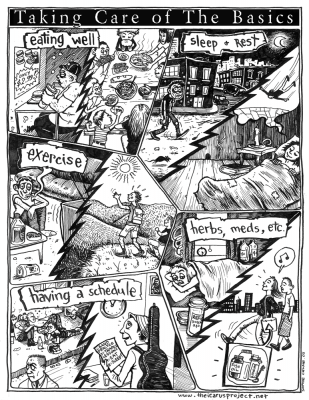
Sophie Crumb’s self-care flyer for The Icarus Project

Talk of “societal oppression” and “urban shamanism” may induce woozy flashbacks of 1970s identity-politics and the backlash that followed.  Should we worry their printable pamphlets on self-mutilation  don’t urge clients to stop? A close reading shows the pamphlet promotes harm reduction, including many safer substitutes Marsha Linehan would endorse. When project members critique profit-seeking drug companies’ influence on mental health treatment, they have company in the highest and most respected levels of  psychology.

The project celebrates an impressive tenth anniversary this year. Whereas decentralized collectives usually veer from dialectical moderation to the ditches of extremism, Icarus continues to walk a narrow path: meds and therapy are okay, self-care and community are crucial, and mental illness, while no blessing, is not necessarily a curse. This quote from Scatter sums up the project best:

Our society still seems to be in the early stages of the dialogue where you’re either “for” or “against” the mental health system. Like either you swallow the antidepressant ads on television as modern-day gospel and start giving your dog Prozac, or you’re convinced we’re living in Brave New World and all the psych drugs are just part of a big conspiracy to keep us from being self-reliant and realizing our true potential. I think it’s really about time we start carving some more of the middle ground with stories from outside the mainstream and creating a new language for ourselves that reflects all the complexity and brilliance that we hold inside.

In the 1960s and 1970s, the Whole Earth Catalog provided tools for those ready to challenge social and economic norms. Today, Icarus does the same for those who question psychiatric norms. It also challenges mental health professionals to make “empowering clients” and “person-centered diagnosis” more than platitudes. “Mentally disturbed,”  is synonymous with “unreliable witness”, and yet  no one else can tell us what the experience is like.   If Freud hadn’t analyzed himself, would there be a field of psychology today?

@ 2012 Jonathan Miller All Rights Reserved

Leave a comment

Filed under Bipolar Disorder, Borderline Personality Disorder, The Client's Side